IPv4 vs IPv6 - A Deep Dive
"Understanding the evolution of IP addressing, from IPv4 to IPv6, with real-world usage, technical concepts, and code examples."
By Tushar
09/04/2025
IPv4 vs IPv6: Which is Better?
The Internet as we know it runs on IP addresses, which uniquely identify devices online. For decades, IPv4 served this purpose. But with billions of devices online today, IPv4’s limitations have led to the rise of IPv6. This blog explains the differences, transition strategies, technical concepts like subnet masking and IP address classes, and even offers some coding examples.
What is IPv4?
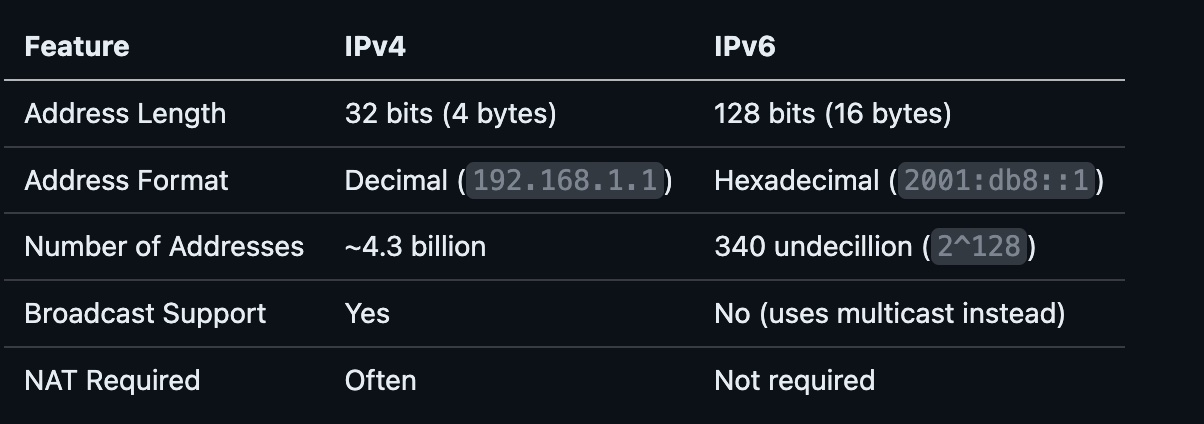
IPv4 (Internet Protocol version 4) uses 32-bit addresses, usually written in dot-decimal notation like 192.168.1.1.
- Maximum addresses: 2³² = ~4.3 billion
- Format:
X.X.X.X(e.g.,172.16.254.1) - Widely deployed since the early internet days
Limitations of IPv4
- Address exhaustion due to IoT and mobile boom
- Heavy reliance on NAT (Network Address Translation)
- Not optimized for security or future growth
What is IPv6?
IPv6 is the next-gen protocol with 128-bit addresses. It’s written in hexadecimal, e.g., 2001:0db8:85a3::8a2e:0370:7334.
- Total addresses: 2¹²⁸ (~340 undecillion)
- No need for NAT
- Built-in security (IPSec)
- Simplified headers and routing
IPv4 vs IPv6: Key Differences
Transition Strategies to IPv6
Migrating the entire internet to IPv6 overnight is impossible. Transition happens via:
- Dual Stack: Devices run both IPv4 and IPv6
- Tunneling: Encapsulate IPv6 packets in IPv4
- Translation: Convert packets using NAT64/DNS64
- Carrier-Grade NAT (CGNAT): Extends IPv4 temporarily
Subnet Masking in IPv4
A subnet mask determines how IP addresses are split into networks and hosts.
Example:
- IP:
192.168.1.10 - Subnet Mask:
255.255.255.0 - CIDR:
/24(24 bits for network)
CIDR Notation
CIDR (Classless Inter-Domain Routing) uses suffixes like /24 instead of masks.
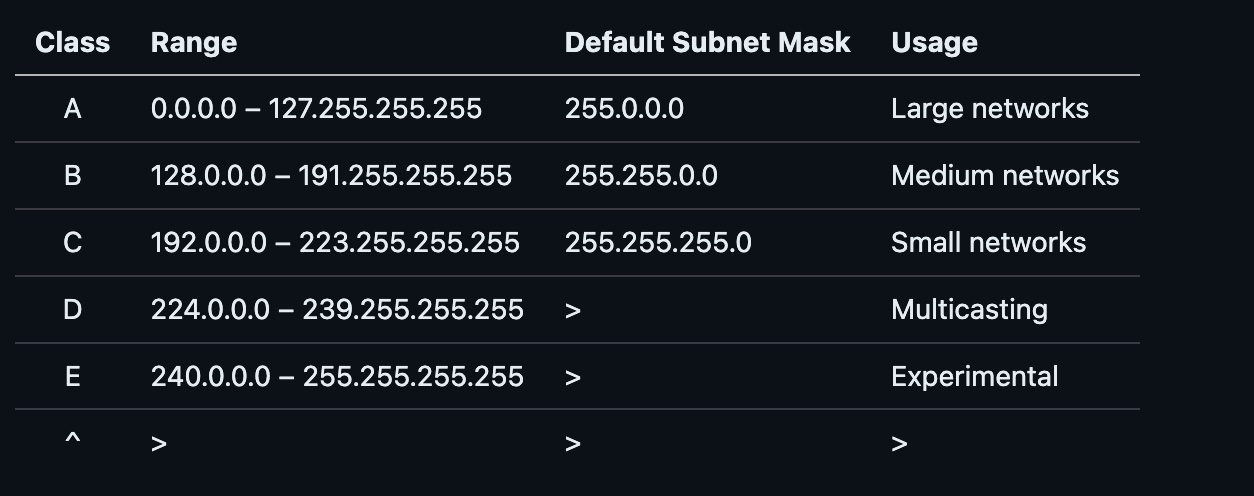
IP Address Classes in IPv4
IPv4 is divided into classes to simplify address allocation:
Subnetting in IPv6
IPv6 doesn’t use subnet masks the way IPv4 does. Instead:
- Subnets typically use
/64(first 64 bits for network) - Host ID is the last 64 bits
- Example:
2001:db8:abcd:0012::/64
Real-World IPv6 Adoption (2025)
Why IPv6 is Critical
- IPv4 can't handle the scale of modern networks
- IPv6 enables IoT, 5G, and modern internet applications
Adoption Statistics
Source: Google IPv6 Statistics
- 🌍 Global: ~47%
- 🇮🇳 India: >65%
- 🇺🇸 US: ~51%
- 🌐 Leading ISPs and mobile networks have full IPv6 rollout
IPv6 in Code: Examples
✅ JavaScript (Node.js) IPv6 Server
const http = require('http');
const server = http.createServer((req, res) => {
res.end('Hello from IPv6 server!');
});
server.listen(3000, '::1', () => {
console.log('Server listening on http://[::1]:3000');
});✅ C++ IPv6 Client (Linux/Unix)
#include <iostream>
#include <cstring>
#include <arpa/inet.h>
#include <unistd.h>
int main() {
int sockfd = socket(AF_INET6, SOCK_STREAM, 0);
sockaddr_in6 serverAddr {};
serverAddr.sin6_family = AF_INET6;
serverAddr.sin6_port = htons(8080);
inet_pton(AF_INET6, "::1", &serverAddr.sin6_addr);
if (connect(sockfd, (sockaddr*)&serverAddr, sizeof(serverAddr)) == 0) {
std::cout << "Connected to IPv6 server!" << std::endl;
} else {
perror("Connection failed");
}
close(sockfd);
return 0;
}IPv6 Best Practices
- ✔️ Use DNS instead of hardcoding addresses
- ✔️ Prefer CIDR (
/64,/56, etc.) over manual subnetting - ✔️ Ensure firewalls and routers support IPv6
- ✔️ Test using tools like
ping6,traceroute6, etc. - ✔️ Deploy dual stack during migration
Final Thoughts
IPv6 is no longer optional—it’s essential. As the world scales up in connected devices, only IPv6 can offer the necessary flexibility, security, and scalability.
Ready to build the internet of the future? Make sure your stack supports IPv6 today.